
A Willingness to Wait
A Reflection for the 3rd Sunday of Advent
We frequently extol John the Baptist’s virtue of humility, pointing to declarations such as “He must increase, I must decrease” as a powerful example of a humble heart. While that is true, I don’t think it’s the whole truth. If we limit our understanding of John’s humility to those types of comments, we risk ignoring one of the most important ways that we must live out humility.
What we tend to miss is that John the Baptist’s humility is most perfectly expressed through his posture of waiting.
In the Gospel, an imprisoned John sends his disciples to ask Jesus if he is “the one who is to come,” biblical code for the Messiah. Understandably, John is trying to grasp Jesus' mission in the world. Remember, he had previously identified Jesus as the Messiah at the Jordan River. Can you imagine that moment of relief when John, under the weight of generation upon generation of believers who had waited for God’s promise to be fulfilled, could finally say, “The waiting is over.”
But just as John was experiencing the joyful gratitude of promises fulfilled, he was confronted with a difficulty. John, like many in his time, may have expected the Messiah’s kingdom to show itself more visibly and powerfully in the world. Yet Jesus was clear that establishing a purely political kingdom was not His mission. It is not difficult for us to be able to enter into John’s confusion – “Is this what the Messianic kingdom looks like, or have I misunderstood?” This is why the way John phrased his question is so important: “Are you the one who is to come, or should we look for another?”
Notice what he didn’t ask: Why aren’t you establishing a kingdom? If you’re here to free the imprisoned, why am I still behind bars? If you are the promised one, why do things seem as horrible as ever?
His question wasn’t accusatory; it didn’t challenge why Jesus wasn’t conforming to his expectations. The Baptist just wanted to know, “Am I right, or should I keep waiting?”
John’s question reveals a willingness to wait.
John was ready to return to a posture of waiting, if needed. And that, beyond anything else, is a fruit of his profound humility.
John knows the promises that God has made to His people and that Israel has waited for the Messiah for what felt like forever. St. Augustine spoke about the dramatic scope of God’s promises when he said,
“God, who is faithful, put himself into our debt, not by receiving anything {from us}, but by promising so much. A promise was not sufficient for him; he chose to commit himself in writing as well, as it were, making a contract of his promises.”
Yes, John deeply felt the weight of how long God’s people had waited and longed for the promises that God had bound Himself to. And with John’s extreme personality, we wouldn’t be surprised if he were impatient in wondering when, finally, the Lord would make good on His promises.
But John was resolute in surrendering His will to the Lord’s. That is what real humility is – recognizing that only Our Heavenly Father knows the best way to bring His promises to fulfillment. John knew that God is faithful to His promises and that, when they are fulfilled, they are fulfilled in ways far greater, far more amazing than even the wisest of prophets could have ever foreseen.
John’s patient waiting was an exercise of his humility, his wholehearted surrender to the will of God.
Yet it was that very patient waiting that expanded his vision so that, when he saw Jesus, he recognized Him. St. Cyprian said it this way:
“Patient waiting is necessary if we are to be perfected in what we have begun to be, and if we are to receive from God what we hope for and believe.”
Patience isn’t simply about God waiting for the right time. It is a process where something is already happening: God is working on us, transforming us, making us capable of receiving what He plans to give. Think about Israel and its expectations of the Messiah. Generation after generation passionately prayed for the Messiah. God, through the prophets, even told them what to look for and the signs that would accompany him. And yet many still missed Him when He came! They couldn’t receive the gift that Jesus is because their expectations of a Messiah were too small.
It was precisely this patient waiting that allowed John to say ‘yes’ when Jesus finally came.
This isn’t just important for John. It’s essential for us.
How many times do we cry out in frustration, “What are you waiting for, Lord,” or “Why aren’t you doing anything Jesus,” or, if we’re honest, “Lord why have you broken your promise to me?” I’m sure that happens to you; I know it does to me. But that’s because I don’t have the humility of the Baptist. That’s because I’d rather be actively controlling rather than patiently waiting. That’s most definitely because my expectations of God are too small.
We need to cultivate a willingness to wait.
So, how do we wait like John … although without losing our heads in the process?
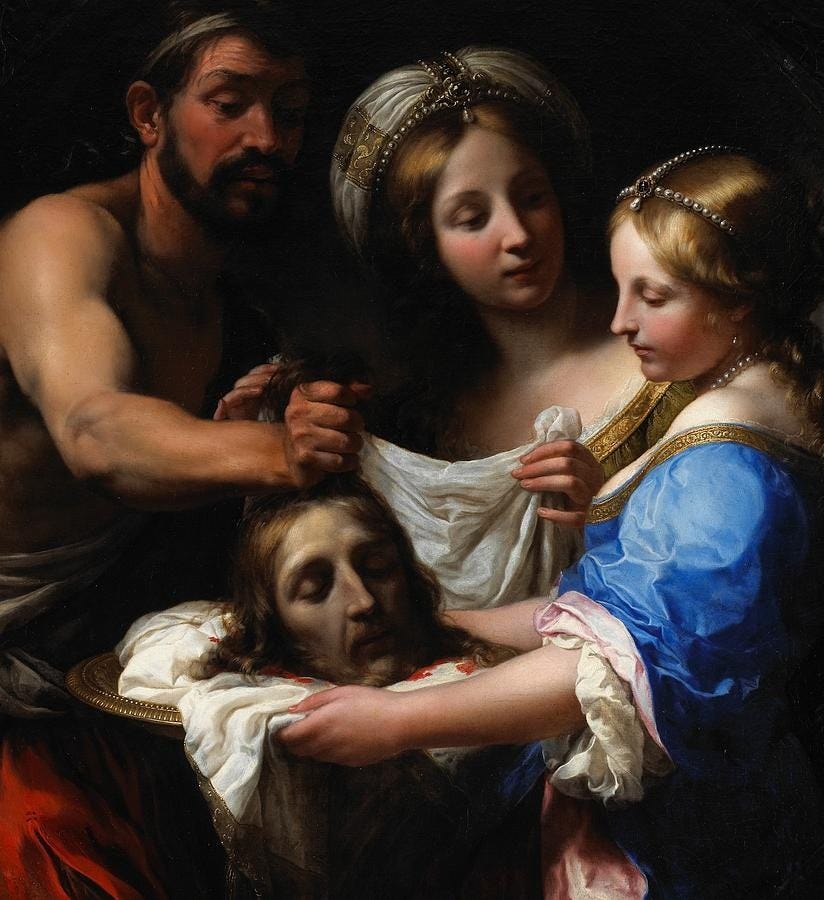
John is actively waiting. He is vigilant in seeking out the fulfillment of God’s promise. He is expecting it, seeking out the signs of its coming. He is preparing himself to recognize and receive the Messiah when He comes. Patiently waiting for God to fulfill His promises doesn’t mean sitting around and doing nothing! Far, far from it. We must 1) Know what God has promised, 2) Prepare ourselves to receive His promises, and 3) Keep vigilant for the signs of their unfolding. We know what God has promised by immersing ourselves in, as Augustine said, the contract with us He Himself wrote – the Scriptures. We prepare ourselves to receive His promises by shedding the things from our lives that we use to avoid experiencing the great grace of feeling incomplete. And finally, we keep vigilant by the constant expectation that we will see God’s grace every day, and the intentional naming of those graces at the end of our day.
John is contagiously waiting. Just because John is waiting doesn’t mean he is keeping to himself! As he waits, he stands by the Jordan and baptizes, helping others to enter into a posture of waiting. Even from prison, his waiting is not closed in on itself. He sends his disciples to Jesus. His questions, his searching, actually bring other people closer to Christ. Our waiting can do the same. When we keep trusting God in the long illness, in the stubborn sin we keep confessing, in the broken relationship that isn’t healed yet, the people around us see a different way to live. They know that it is possible to wait without despair, to hope without having all the answers. When we witness to the world by patiently wait because we know God is faithful to us and promises nothing shy of making us God-like, well, then that longing for Infinite Love is awakened in more and more hearts.
We say Advent is a season of waiting, but in truth, our whole life is a season of waiting.
The question is not if we will have to wait for the fulfillment of all of God’s promises, but how we will wait.
Will it be like John, actively, contagiously, ready to be surprised when Jesus fulfills His promises in ways far greater than we would dare to imagine?