
Becoming a Desert
A Reflection on the 2nd Sunday of Advent 2025
N.B.: Please feel free to forward this reflection to anyone you think might appreciate it, and encourage them to sign up to receive future writings.
There are few biblical figures I am as captivated by as John the Baptist, so much so that I’ve claimed him as my confirmation saint (my saint name was ‘John’ with no distinguishing information, so I’ve taken the liberty of claiming the camel hair-wearing prophet). His eccentricity should repel rational people. Yet, as our Gospel reading for Sunday says, “at that time Jerusalem, all Judea, and the whole region around the Jordan were going out to him…” I call passersby a brood of vipers while eating insects and people cross the street to avoid me; John does the same and is called a prophet! But that uniqueness demands our attention because when people in scripture act contrary to expectations, the Holy Spirit is trying to communicate something important to us.
John’s demeanor and, well, let’s call them “lifestyle choices,” are not details that just add color to the story. Scripture is short on details, so if it gives us one, it is an important clue to the deeper meaning being communicated. The Holy Spirit is telling us something fundamental to John’s mission when we are told that he “wore clothing made of camel’s hair and had a leather belt around his waist. His food was locusts and wild honey.” To understand why, we need to approach our Gospel with a biblical worldview.
Remember that, for those who saw John, the experience of the desert was charged with meaning. Think of Moses and the burning bush, think of Israel’s encounter with God at Sinai and their 40 years with his presence in the wilderness, consider God passing by Elijah on the mountain in the desert, just to name a few. To speak of the desert was to speak of being in a place of encounter with the Lord.
To be sure, the experience was usually one of trials and temptations. In the desert, you only have what God provides to you. All illusions of being self-sufficient fall away as the true poverty of who we are becomes our most dependable resource. It is not despite the barrenness of the desert environment that we are able to encounter the God who has been pursuing us – it is because of it!
With that in mind, let’s turn back to the Baptist. His dress, his diet, his demeanor are all a type of barrenness, a surrender of self-sufficiency, a voluntary emptiness. John isn’t just in the desert; he has become a desert. All of those “lifestyle choices” are symbols that point to the truth that the locus of encounter with God has shifted. Now, we can encounter our God in and through others.
Through the Baptist, we encounter God, we encounter Jesus.
But here is the fun part – it’s not just John!
Every disciple must become a desert.
Every disciple must become a place where others encounter Jesus.
We no longer need to go out to a sand-filled desert to find ourselves face-to-face with the One who is pursuing us. No, He is now present and active in so many ways, in so many places. And an important one is within the heart of every baptized disciple.
So do we have enough love within us to become a desert where others can encounter Jesus?
Do we have enough courage to become a desert?
I say courage because that’s what it takes for us who, too many times, are addicted to comfort. Because you can be sure that becoming a desert so others can encounter Jesus through you is uncomfortable. So what, then, does it take for us to be a desert? What, then, does it take for us to become a place where others encounter Jesus? Well, we only need to look at the two main characteristics of the Judean Desert to find out:
Empty. The Judean Desert has miles and miles of … nothing. Some deserts have different forms of life or dramatic landscape features. But much of the Judean Desert is barren and empty. To become a desert, we must allow ourselves to become empty. But gosh, let me tell you, that is much easier said than done. We humans, we are just so afraid. It’s a consequence of original sin. Remember that, when God was looking for our original parents after they had eaten the forbidden fruit, Adam revealed they were hiding from God because they were afraid. And when we are afraid, we unconsciously grasp for things to bring us comfort, or to numb us. Yet the more we fill ourselves with “stuff,” the harder it will be for people to encounter Jesus through us. Ask yourself: What might you be distracting yourself with to avoid the beautiful emptiness that brings us face-to-face with Love Incarnate?
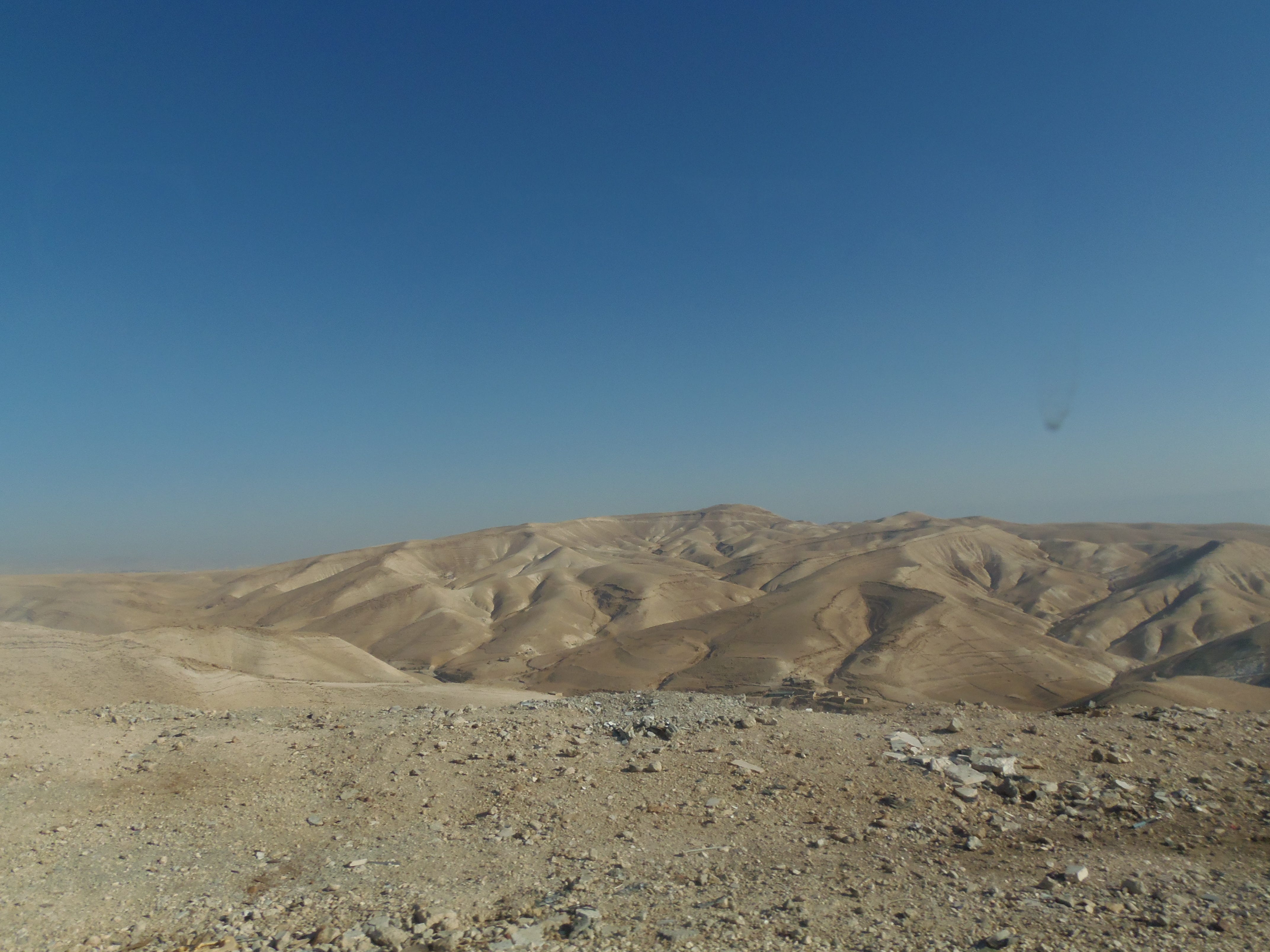
Extremes. It is a unique environment indeed where, within the same 24-hour period, you could be at risk for heat stroke and hypothermia - but that is the Judean Desert! There is nothing moderate in the desert, and so neither should there be in our relationship with Jesus. Yet, sadly, there is an epidemic among churchy folk of pusillanimity. The pusillanimous person avoids seeking the greatness that is their inheritance as a beloved child of our Heavenly Father. They avoid being too extreme in their vision and desires. They are, literally, “small-souled.” The magnanimous person, on the other hand, seeks after great things in a way suited to their real gifts. They are not satisfied with mediocrity; they are not satisfied with getting by. They know that our call is a divine one, and we are thereby empowered to carry out amazing, truly miraculous things. Ask yourself: Do I settle for “good enough” in my relationship with Jesus? Do I have a holy ambition to use my charisms and gifts in the service of the Kingdom?
Being emptied of ourselves and refusing a mediocre, “small-souled” discipleship—that is how we become a desert where others can truly encounter Jesus.
And that is exactly what Advent is for. John stands in the wilderness and cries out, “Prepare the way of the Lord, make straight his paths.” Oh sure, the desert around him is barren, but the most important thing is that his heart is emptied and on fire, ready to receive and share the One who is coming.
The good news is you don’t have to wear camel hair or eat locusts.
But you do have to let the Holy Spirit make your life into a desert where Jesus can be known.
If we let Him do that in us, then this Advent will not just be about getting ready for Christmas. It will be about preparing a way so that, through us, others can not only know but also experience the living and active presence of our infant God in their lives.
Wonderful insight as always. I love how the Holy Spirit works through you to show us a different way to see things.