
On Fear & Faithfulness
A Reflection for the Feast of the Holy Family 2025
Blessed Christmas to all of you. Please consider sharing this reflection with someone else and encouraging them to sign up for this Substack.
Joseph’s willingness to be immediately responsive to God’s will, to step out of his life and drop everything at a moment’s notice, is heroic. There was a pattern in his life where God abruptly — at least from Joseph’s perspective — changed everything for him in an instant. Yet his faithfulness didn’t free him from fear. In fact, it led him right into it.
And it just may do the same for us.
Our Gospel tells us that, immediately after Joseph followed yet another dramatic course correction from the Lord, he was gripped by fear:
“But when he heard that Archelaus was ruling over Judea in place of his father Herod, he was afraid to go back there.”
Faithfulness to God led him into fear. That’s because the fidelity of the saints doesn’t mean foolishness in the world. Joseph, of course, notices the dangers around him. Who wouldn’t?! Yet his fear reveals a profound truth: Faithfulness requires us to step into a place of total vulnerability.
Undoubtedly, that was an uncomfortable place for Joseph. Yet his love of God motivated him to choose holy vulnerability over comfort. And because of that, prophecy was fulfilled: “He shall be called a Nazorean.” Precisely by yielding to threats, by seeming to lose in the eyes of the world, Joseph became an important cooperator with the Son of God in accomplishing the Father’s eternal design.
Fear is part of our experience. Being a disciple doesn’t change that. But the miracle of Christmas reveals that fear neither has the last word nor stands as an obstacle to Jesus’ victory, if it leads us into vulnerability before the Father.
Christmas is precisely the mystery where God enters into fear and vulnerability. He enters a world where a father can be afraid, where a mother can be displaced, where a child can be threatened. The Holy Family is not preserved in glass, untouched by the harshness of real life. They are drawn right into it — into uncertainty, into danger, into the strain of uprooting and beginning again.
Years ago, I suggested in a homily that our nativity scenes, as beautiful as they are, can accidentally soften the Gospel’s edge. The Holy Family’s life was not a polished tableau; it included uncertainty, messiness, and danger. Some of my parishioners had a visceral reaction to the possibility that the experience of the Holy Family was far more raw than the lights and creches convey.
I wasn’t surprised, because I know that tendency myself. I want to clean up the Holy Family and make them safe; to prevent them from coming too close to the messiness of my life. Because if they do, if they become involved not in the perfect version of my life that exists in my head but the rough and wavering reality that makes up my daily life, well, then that will require me to be vulnerable. And no one wants to be vulnerable.
But again, Joseph comes to our aid. Notice what God does in Joseph’s life. He does not shame him for fear. He does not tell him to pretend it isn’t there. He doesn’t take advantage of Joseph’s vulnerability. He guides him through it. Joseph’s fear becomes part of the path of obedience. His prudence becomes part of the providence. The very thing that could have paralyzed him becomes, in the hands of God, a means of fulfilling the Scriptures.
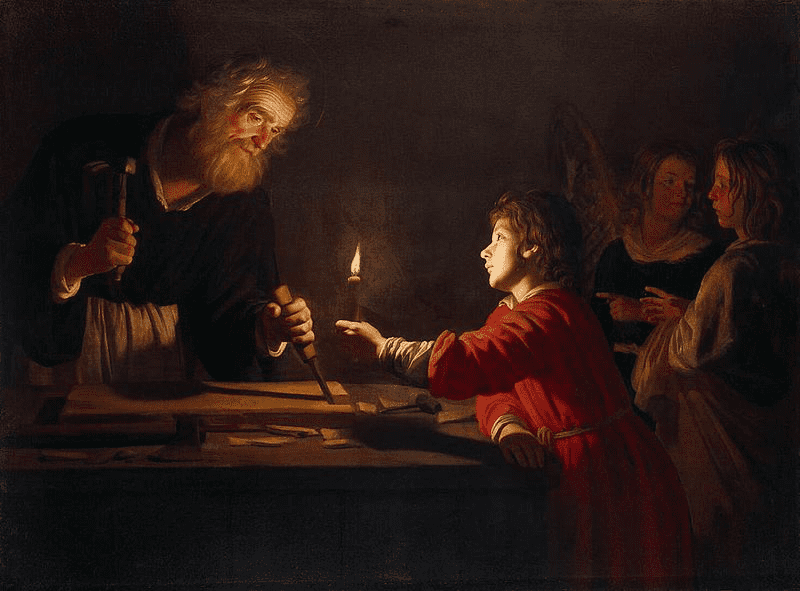
Faithfulness is not the absence of fear; faithfulness is allowing fear to make us vulnerable before our Heavenly Father.
Too many times, there are fears we carry that feel like failures: fear for our children, fear for our marriage, fear for our health, fear for our aging parents, fear for the future, fear about the Church, fear of what we cannot control. Sometimes we imagine that if we were “really faithful,” we would be beyond such things. But Joseph shows us something different - the power of vulnerability.
Vulnerability is the courage to live without the illusion of control. It is the willingness to stand in the truth that I cannot protect what I love by my own strength. I cannot guarantee outcomes. I cannot force tomorrow to be kind. Yet it is the decision that, in the face of all of that, I will still love. I will still obey. I will still take the next step the Lord gives me.
Joseph’s strength is real, but it is a strength that admits dependence.
There is a kind of toughness our world admires that is, in reality, just armor. It keeps us from being hurt, but it also keeps us from being reached. It keeps God at a safe distance. We prefer the polished, stable “Hallmark” version of the Holy Family because it lets us admire them without having to meet them. But the Gospel refuses to let that happen. God places His Son not only in a manger, but in a family that must flee in the night. He places Him into the hands of a father who is afraid. That is not an accident. It is a revelation.
Because the Lord does not save us by bypassing vulnerability. He saves us through it.
As we celebrate this great octave of the nativity of our Lord, a birth that was permeated with vulnerability and risk, Jospeh obedient fear prompts us to ask ourselves: Where am I avoinding being vunerable? Notice, friends, I say where, not if. Because we all do it. Because all of us, somewhere in our life, allow the fear to paralyze us rather than push us into a posture of vulnerability before our Heavenly Father.
Yet in a real way the key to holiness is to become more vulnerable, not less.
To become more dependent, not less.
To recognize our insufficiency, not to be blinded by presumed self-sufficiency.
In this great season of Christmas, we worship a vulnerable God born into a vunerable family who found fear and danger at every turn. That is the key to experiencing the lasting power and peace of our Father; that is the roadmap to transforming fear into freedom; that, beyond anything else, is the secret to allowing our family to become a holy family.
Incredible!!! A lot to reflect on here about fear that I never thought of before.